
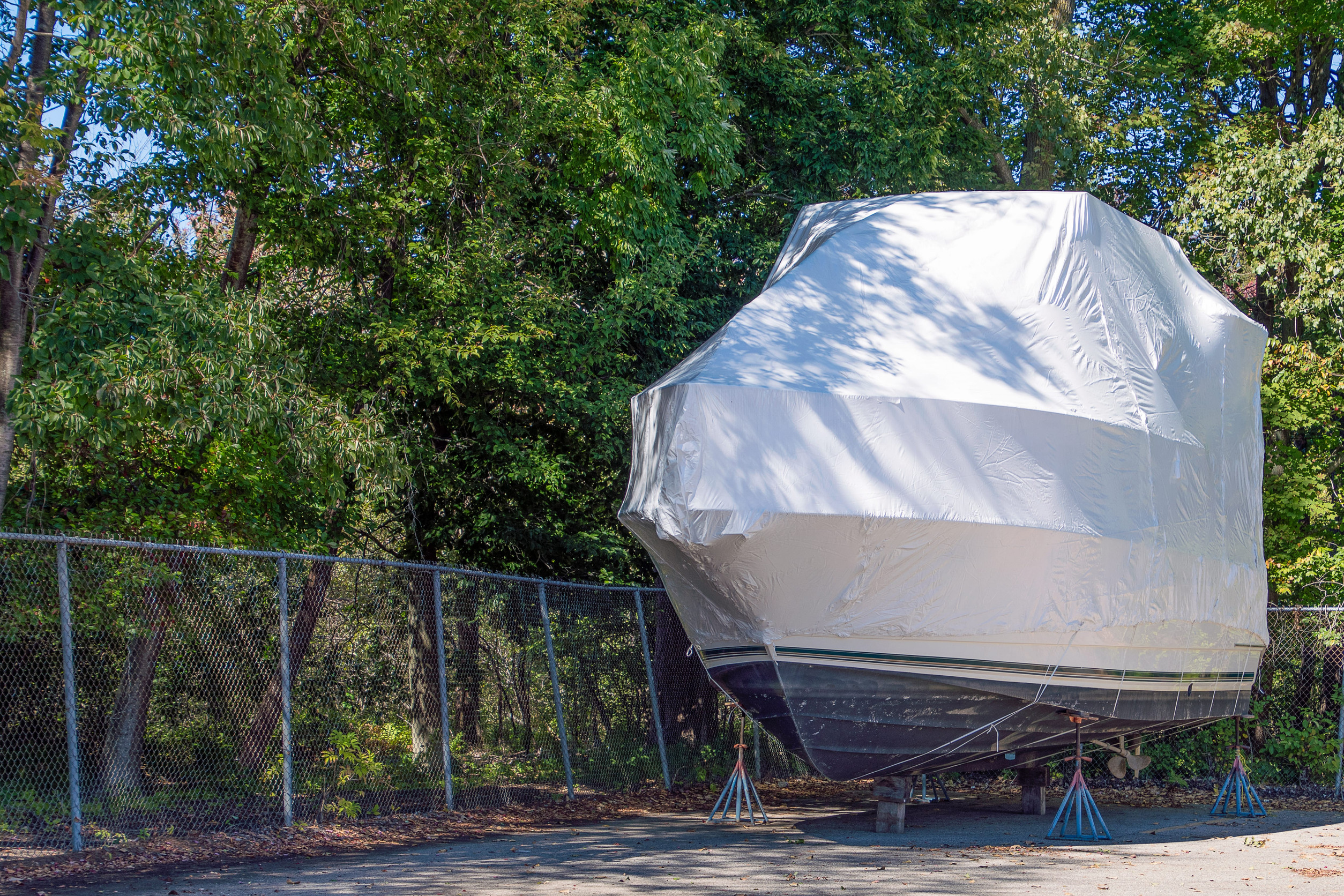
For Minnesota boat owners, fall comes with a familiar routine. The days get shorter, temperatures begin dropping, docks and lifts come out of the water, and eventually the boat gets pulled for the season.
Once your boat is winterized and safely stored, you may wonder: Do I really need boat insurance all winter?
It’s a reasonable question. After all, your boat may not touch the water again for six months.
The important thing to remember is that taking a boat off the lake doesn’t eliminate every risk. Boats can still be damaged by fire, theft, vandalism, falling objects, severe weather, or other unexpected events while sitting in storage.
Understanding boat insurance winter storage can help Minnesota boat owners decide what coverage makes sense during the off-season and avoid discovering a coverage gap after a loss.
Generally, an annual boat insurance policy doesn’t automatically disappear simply because boating season ends. Your policy continues according to its terms unless it is changed, canceled, or non-renewed.
Exactly what remains covered depends on your individual policy.
Boat insurance policies can include several different types of protection, such as physical damage, liability, medical payments, theft, and coverage for certain equipment or accessories.
Some risks become much less significant during winter storage. You probably aren’t going to collide with another boat while your pontoon is sitting in a storage building.
Other risks remain.
That’s why it’s important to review your winter boat insurance rather than assuming you no longer need coverage once the boat leaves the water.
It can be tempting to cancel your Minnesota boat insurance after the last trip of the season and purchase another policy in spring.
Before doing that, consider what could happen while the boat is stored.
Depending on the policy, boat insurance may provide protection against losses involving:
Imagine your boat is stored in a detached garage and a fire damages both the building and watercraft. Or someone steals the boat and trailer from a storage lot. Perhaps a severe winter storm damages an outdoor storage structure.
The fact that the boat wasn’t being used doesn’t necessarily mean it wasn’t exposed to risk.
Canceling coverage could also create a lapse in your insurance history. Before making any seasonal policy change, it is worth asking your insurance professional how your specific carrier handles winter storage and whether other options are available.
Not every insurance company structures seasonal boat coverage the same way.
Some insurers may account for Minnesota’s short boating season when establishing annual premiums. Others may offer different options based on how, when, and where a watercraft is used.
The important point is not to assume that you should automatically cancel or substantially reduce coverage simply because the boat is stored.
Instead, ask questions such as:
Insurance carrier rules differ, so the answers should come from your actual policy rather than a general assumption about boat insurance.
Where you keep your boat during winter matters.
The Minnesota Department of Commerce notes that the location where a boat is kept is one factor insurers may consider when determining boat coverage and premium.
A boat could spend the winter:
Each situation presents somewhat different risks.
Indoor storage can protect a boat from snow, ice, UV exposure, and direct weather conditions. However, indoor storage does not eliminate risks such as theft, fire, vandalism, or structural damage to the building.
If you’re using a commercial facility, find out what protection the facility provides and what remains your responsibility.
Do not assume the storage company’s insurance automatically covers your boat.
Outdoor storage can expose a boat to additional weather-related risks.
Snow accumulation, ice, wind, falling tree limbs, animals, and temperature changes may all create potential problems.
Good winter preparation becomes particularly important when a boat will remain outdoors for several months.
This is another area where assumptions can create problems.
The Minnesota Department of Commerce explains that personal property coverage under a homeowners policy might provide limited physical-damage coverage for a small boat, motor, and trailer. However, coverage is typically limited, and liability protection may also be restricted.
A boat of significant size will generally require separate boat insurance in Minnesota.
For many Minnesota families, that includes the types of boats commonly found throughout the Brainerd Lakes area: pontoons, fishing boats, larger runabouts, and other higher-value watercraft.
Don’t assume storing the boat in your garage suddenly makes it fully covered by your homeowners insurance.
The boat remains a watercraft, and the policy language matters.
When reviewing boat storage insurance, remember that your trailer is part of the picture.
Boat owners sometimes focus so heavily on the watercraft itself that they overlook the equipment used to move it.
Ask whether your policy covers the trailer and what limits apply.
Also consider what would happen if:
The Minnesota Department of Commerce specifically notes that additional coverage can be purchased for trailers and accessories, making this an important part of a seasonal insurance review.
Insurance should never be treated as a substitute for proper maintenance.
If you winterize a boat in Minnesota, you’re taking steps to protect the watercraft against damage caused by freezing temperatures and months of inactivity.
The Minnesota DNR recommends preparing boats for winter storage every fall. Depending on the type of boat and engine, preparation can include draining water, servicing the engine and fuel system, checking components, changing fluids, and storing equipment properly.
Proper winterization may help prevent costly damage such as cracked engine components, corrosion, fuel problems, or freeze-related damage.
Insurance policies generally distinguish between sudden covered losses and problems resulting from maintenance, deterioration, wear and tear, freezing, or neglect.
The exact exclusions and conditions vary by carrier and policy.
That makes proper winterization important for two reasons: it protects your boat physically, and it reduces the chance that you’ll face damage that isn’t covered by insurance in the first place.
Keep records of professional winterization or maintenance when applicable. Receipts and service records can also be useful for maintaining a history of the care given to your boat.
A boat often contains much more than the hull and motor.
Depending on how you use your watercraft, you might have:
Don’t assume every item automatically receives the same coverage as the boat itself.
Policies can contain limits or different provisions for equipment, personal belongings, permanently installed accessories, and aftermarket additions.
Fall is a good time to remove items that shouldn’t spend the winter in the boat and review how higher-value equipment is insured.
Possibly—but this is a question to discuss with your insurance professional rather than making the change automatically.
Some boat owners may have seasonal coverage options available. Others may find that their annual premium already reflects the fact that Minnesota boats are typically used only part of the year.
Reducing physical damage coverage during storage could save money in some situations, but it could also remove protection against the very losses most likely to occur while the boat is sitting unused.
Consider the value of the boat, where it is stored, whether it is financed, the policy terms, and the financial impact if the boat were stolen or destroyed.
If your boat is financed, also remember that your lender may require certain physical damage coverage.
Before putting your boat away for another Minnesota winter, take a few minutes to review both the boat and the insurance protecting it.
Consider this simple checklist:
A short conversation in fall can provide much more clarity than trying to understand your policy after winter damage occurs.
Boats change over time.
You may add electronics, replace a motor, buy a different trailer, change storage facilities, move the boat to another lake, or purchase a newer watercraft.
Your insurance should keep up with those changes.
National Insurance Brokers – Hice Agency provides recreational insurance for boats and other recreational vehicles and serves Minnesotans through locations in Baxter, Grand Rapids, Longville, and Remer. As an independent insurance brokerage representing more than 40 insurance companies, the agency can review options from multiple carriers rather than being limited to one insurer.
For boat owners in the Brainerd Lakes area and throughout Minnesota, an annual fall review can be particularly useful because it naturally coincides with winterization and storage.
Putting your boat away for winter doesn’t necessarily mean putting its risks away too.
A stored boat can still be damaged, stolen, vandalized, or affected by other covered events. That’s why canceling boat insurance during winter storage without first understanding the consequences can create an unnecessary coverage gap.
Instead, treat fall as an opportunity to review your Minnesota boat insurance.
Know where your boat will be stored, understand what physical damage protection remains, check your deductible, verify trailer and equipment coverage, and ask whether your policy includes any seasonal provisions.
Then give the boat itself the same attention. Properly winterize your boat in Minnesota, document its condition, protect valuable equipment, and keep maintenance records.
When spring finally returns, you’ll be in a better position to focus on getting back on the water rather than sorting through an insurance surprise.
For questions about boat insurance, winter storage coverage, recreational insurance, or other insurance needs in Minnesota, National Insurance Brokers – Hice Agency provides coverage guidance for individuals and families throughout the state.
National Insurance Brokers – Hice Agency
7111 Forthun Rd., Suite 200 A
Baxter, MN 56425
Phone: 218-203-5540
Email: info@insuredbaxter.com
At National Insurance Brokers, your privacy is our priority. We will never sell, share, or distribute your personal information to third parties. The information you provide is used only to connect you with one of our expert brokers to help find the best coverage for your needs. Your data is kept secure and confidential at all times.
By submitting this form and signing up for texts, you consent to receive text messages from National Insurance Brokers at the number provided, including automated messages and messages related to Customer Care. Consent is not a condition of purchase. Msg & data rates may apply. Msg frequency varies. Unsubscribe at any time by replying STOP or clicking the unsubscribe link (where available). Reply HELP for help.
Privacy Policy: https://insuredbaxter.com/privacy-policy/
Terms and Conditions: https://insuredbaxter.com/terms-and-conditions/